FAST & FREE U.S. Shipping!
 Financing Available!
 Prices Locked! Beat Tariffs!
 12-Month Warranty
 Proud U.S. Company
 Now Shipping to Canada!
 Call Us Now (800) 617-9522



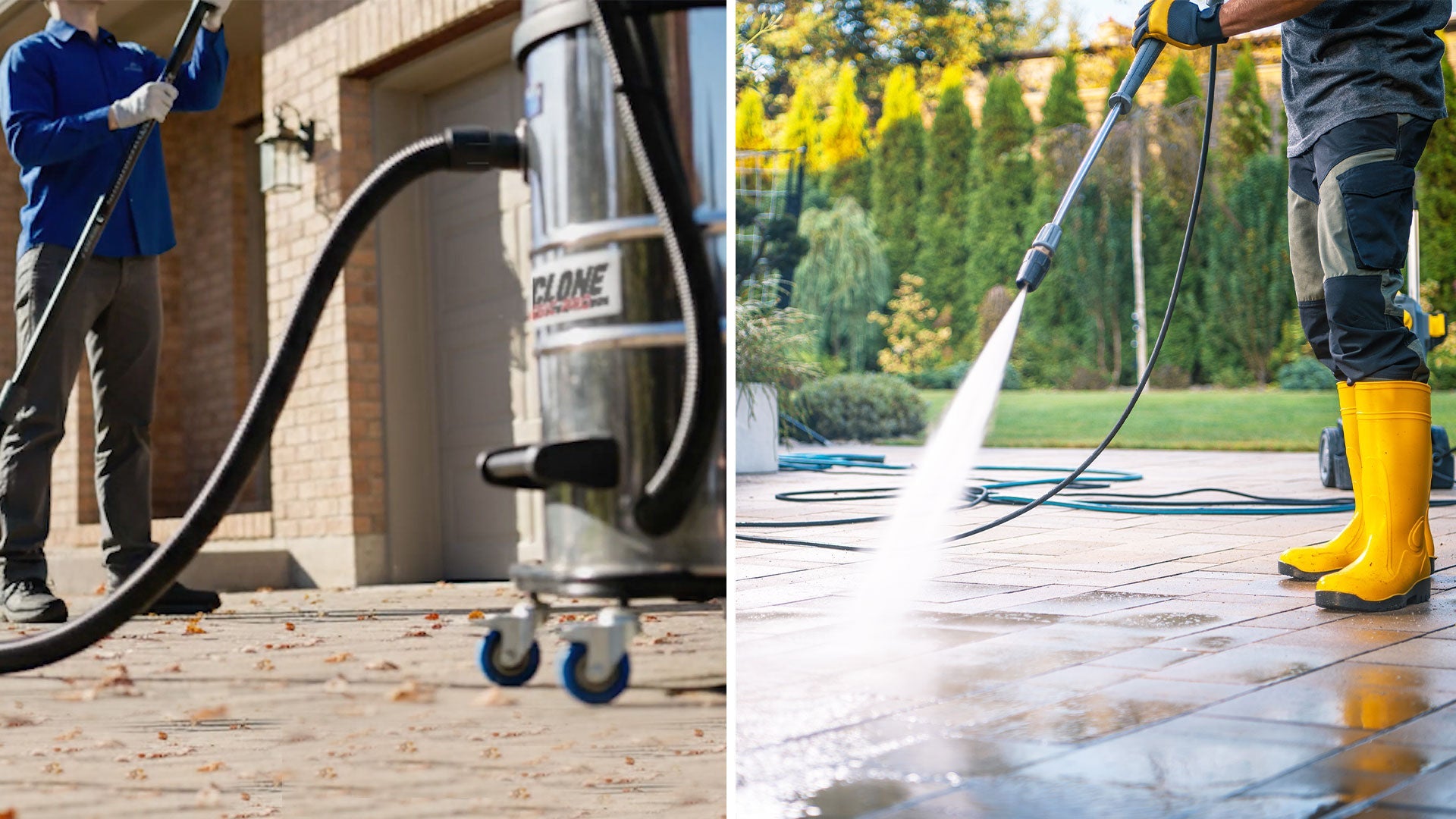
You already own the pressure washer. You know how to sell a house wash. But there's a recurring, high-margin service line that many pressure washing businesses overlook: gutter cleaning. Homeowners dread it, insurance companies recommend it, and it creates a reliable stream of repeat business. The real question isn't if you should add it, but how. Do you adapt your existing pressure washing equipment, or invest in a dedicated gutter vacuum system? This decision impacts your job speed, safety profile, liability exposure, and ultimately, your profit per hour. We're breaking down the operational and financial realities of each method to show why a ground-level vacuum system represents a strategic upgrade for a scaling contractor.
The Contractor's Dilemma: Choosing Your Gutter Cleaning Weapon
Your chosen method dictates your entire service model. It affects how many jobs you can complete in a day, your risk of injury or property damage, the quality and consistency of the result, and the likelihood of earning a referral. The four common approaches are gutter vacuums, pressure washers, leaf blowers, and manual hand cleaning from a ladder. For a professional contractor aiming to build a scalable, reputable business, two of these are immediately disqualified. The real choice is between retrofitting your pressure washer for a task it wasn't designed for or adopting a purpose-built vacuum system. That choice will define your operational efficiency, worksite safety, and competitive edge.
Head-to-Head: Gutter Vacuum vs. Pressure Washing
Many contractors default to using a pressure washer for gutters because they already own one. While common, this approach carries hidden costs and risks that a dedicated vacuum system eliminates.
Pressure washing uses high-velocity water to blast debris from the gutter trough. It can dislodge dry leaves and some loose material, but it creates a significant cleanup burden below, often plastering wet muck onto siding, windows, and landscaping. The core issue is the introduction of water into a drainage system. When executed improperly or with excessive pressure, water can be forced laterally under roof shingles, potentially compromising the waterproof membrane. It can also saturate wooden fascia boards, accelerating rot. For the heavy, wet sludge that commonly clogs gutters, a mix of decomposed leaves, shingle grit, and water, pressure washing often smears and spreads the material rather than cleanly removing it. Operationally, it typically requires ladder use or an unwieldy wand attachment, reintroducing the fall risks you might avoid on a standard house wash.
A gutter vacuum system operates on the principle of dry, contained suction. From a stable, ground-level position, you guide a lightweight, extendable pole into the gutter. A powerful motor creates airflow that pulls all debris, dry leaves, pine needles, wet sludge, even stagnant water, through the pole and into a sealed collection drum. Nothing is displaced onto the ground or the home's exterior. The risk of introducing water damage is virtually nonexistent. You maintain a secure footing throughout the job, drastically reducing your liability.
The operational differences are stark, as this comparison illustrates:
| Feature | Gutter Vacuum System | Pressure Washing |
|---|---|---|
| Primary Method | Dry Suction | High-Pressure Water |
| Debris Removal | Contained in collection tank | Washed out, often onto ground |
| Wet Debris/Sludge | Excellent (direct suction) | Poor (splatter, spread) |
| Dry Leaves/Pine Needles | Excellent | Inefficient (blow around) |
| Risk of Water Damage | Negligible | Present (if misapplied) |
| Job Site Cleanliness | Clean & Contained | Messy (splatter, runoff) |
| Safety Profile | Ground-Level Operation | Often requires ladder work |
| Avg. Job Time (Residential) | 20-30 minutes | 30-45+ minutes |
This data underscores a key point: the vacuum system excels in safety, cleanliness, and adaptability to all debris conditions. The pressure washer's main advantage is leveraging existing equipment, a short-term savings that can be offset by longer job times, increased cleanup labor, and elevated risk.
Why Leaf Blowers and Hand Cleaning Fall Short for Pros
While we're focused on the vacuum vs. pressure washer debate, it's worth briefly explaining why the other methods aren't viable for a professional service model.
Leaf blowers are a tool of convenience for homeowners, not a professional solution. Their effectiveness is limited to completely dry, loose surface debris. They fail against the compacted, damp, or sticky buildup that constitutes most gutter clogs. Furthermore, they create a chaotic secondary mess, blowing gutter contents across the roof, down the siding, and into landscaping beds. This creates additional cleanup work and projects an unprofessional image. Relying on a leaf blower is a reputation risk a serious contractor can't afford.
Hand cleaning from a ladder is the traditional method, and it's fraught with liability. It is inherently slow and physically taxing. According to safety authorities like the Occupational Safety and Health Administration (OSHA), falls from ladders remain a leading cause of serious injury and death in the construction trades. This method also severely limits productivity; constantly repositioning a ladder on a two-story home turns a 30-minute task into a 90-minute ordeal. You cannot scale a business on a method that is this slow, dangerous, and inefficient.
This analysis positions the gutter vacuum as the only tool that marries professional-grade results with a business model built on speed, safety, and scalability.
The GutterProVac Advantage: Built for Contractor Workflow
Acknowledging the vacuum's superiority is the first step. The second is selecting a system engineered for the relentless demands of a contractor's schedule. This is where GutterProVac distinguishes itself. These are not augmented shop vacuums; they are commercial-grade machines designed for all-day operation, heavy debris loads, and maximum uptime.
The flagship GutterProVac Cyclone II 3600W System is the industry workhorse. Its triple 1200W motors deliver 94.56 inches of water lift and 379.6 CFM of airflow, the sustained suction power needed to pull out compacted, wet sludge that would stall lesser machines. The Cyclone II 3600W is available in 20-gallon and 27-gallon stainless steel tank configurations, giving contractors a critical efficiency feature: enough capacity to service multiple homes on a single route without stopping to empty. Paired with aluminum or carbon fiber pole kits, the system reaches up to 40 feet, handling most two-story and many three-story residential gutters with ease from the ground. The integrated cyclonic side inlet acts as a pre-filter, protecting the main filter and motor from fine dust and maintaining consistent suction power job after job. This is the system for contractors committed to making gutter cleaning a core, high-volume service offering. Explore the Cyclone II 3600W commercial gutter vacuums.
For professionals entering the gutter cleaning market or focusing primarily on standard residential accounts, the Cyclone Classic Pro offers robust pro-grade performance in a streamlined package. It provides the essential power and reliability needed to build a new service line without overcomplicating the investment.
The system's real-world performance hinges on its pole and nozzle configuration. GutterProVac's carbon fiber gutter poles are a significant operational advantage. Their high strength-to-weight ratio minimizes operator fatigue over a long workday, a crucial factor when you're lifting and maneuvering a pole for hours. The secure clamp system allows for quick, confident length adjustments. Paired with the appropriate nozzle, an angled nozzle for standard gutter profiles, a gulper nozzle for heavy wet sludge, or a crevice nozzle for compacted debris, you have a tailored solution for every gutter condition you'll encounter. See the carbon clamping gutter pole sets.
5 FAQs for Pressure Washers Adding Gutter Cleaning
1. Can I just use my pressure washer for gutters?
You technically can, but it's not advisable as a primary service method. The risk of causing water damage to roofing materials or fascia is real and could lead to costly repairs or liability claims. It's also a less efficient process, creating more mess and often requiring more time per job. A dedicated tool outperforms an adapted one in both results and risk management.
2. How fast is the ROI on a gutter vacuum system?
The return on investment is typically very rapid. If you charge an average of $150 per gutter cleaning service and invest in a system like the Cyclone II 3600W, the equipment can pay for itself in under 20 jobs. Many contractors report covering their initial cost within the first month of actively marketing the service. The real ROI accelerates when you factor in the time saved per job, allowing you to complete more services each week.
3. Is ground-level cleaning effective on 2nd or 3rd-story gutters?
Absolutely. This is one of its primary advantages. With professional-grade poles that reach up to 40 feet, you can safely and effectively clean high gutters without ever leaving the ground. Every GutterProVac system can also be purchased with a wireless inspection camera that mounts to the pole, allowing you to photograph and video record gutter conditions before, during, and after the job. The recorded files can be attached to invoices or shared with clients as proof of work.
4. What about gutters packed with wet sludge?
This is precisely the scenario where a high-powered vacuum system proves its value. The suction from a commercial-grade unit like the Cyclone II 3600W is designed to pull this dense material directly into the collection tank. A pressure washer would simply blast that sludge across the siding and windows, creating a bigger mess.
5. How do I price gutter cleaning vs. pressure washing?
Gutter cleaning often commands a price point similar to or higher than a basic house wash because it's a specialized, necessity-driven service with high perceived value (preventing water damage, safety). Your profit margin is typically stronger because the job is faster, uses no water or chemicals, and has minimal setup/cleanup time. Pricing is commonly based on home size and linear feet of gutter, not hourly rates.
Expand Your Services, Not Your Liability
The analysis is clear. For a pressure washing contractor looking to integrate a high-demand, high-margin service, a dedicated gutter vacuum system is the professionally superior choice. It delivers faster job times, a dramatically safer work profile, cleaner results, and consistent performance across all gutter conditions. Most importantly, it removes the risk of causing thousands of dollars in water damage to a client's property, a liability that can erase the profit from dozens of jobs.
Stop adapting your current tools for a critical new task. Invest in equipment designed for the specific job at hand. Equip your business with a system built for professional results and operational efficiency, and turn gutter cleaning into a reliable profit center. Discover the complete range of professional gutter cleaning systems and contractor-focused accessories at GutterProVac.