FAST & FREE U.S. Shipping!
 Financing Available!
 Prices Locked! Beat Tariffs!
 12-Month Warranty
 Proud U.S. Company
 Now Shipping to Canada!
 Call Us Now (800) 617-9522




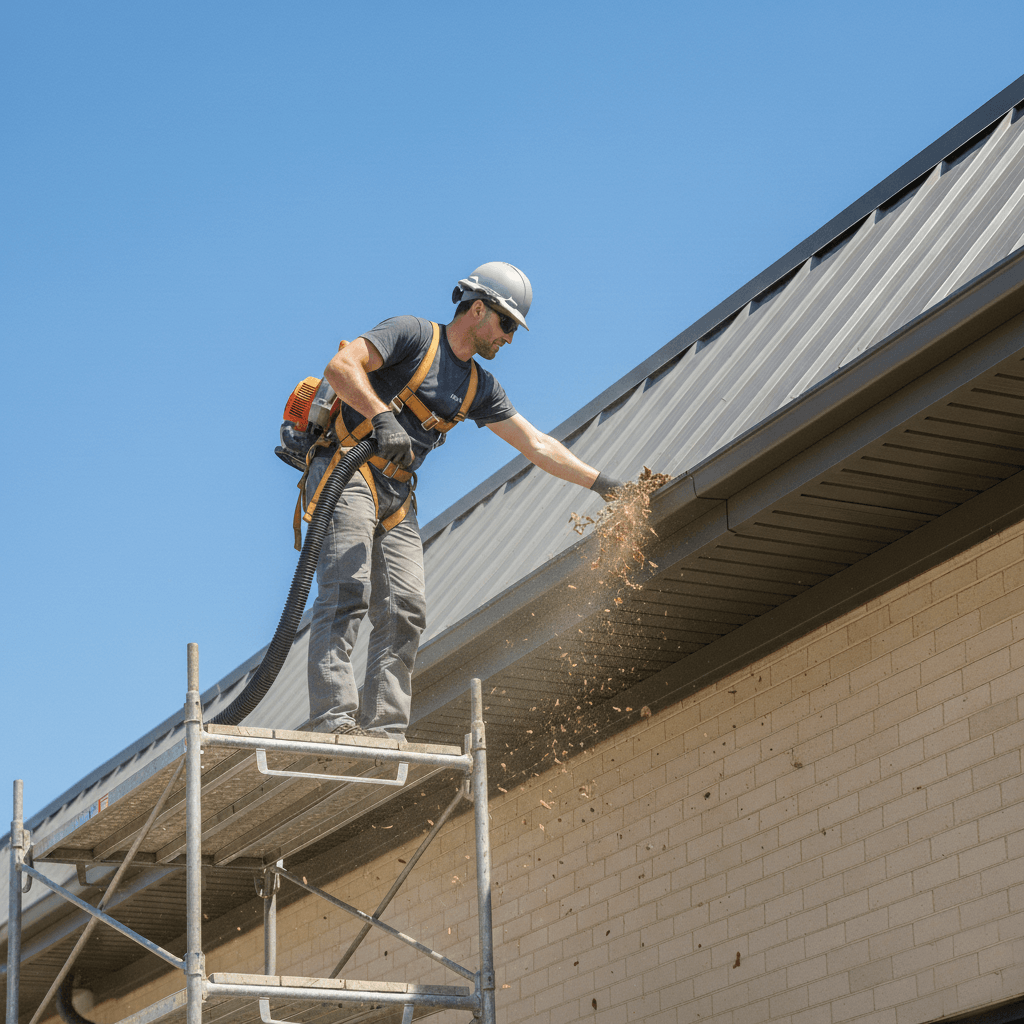
Expert buying guide for contractors and property management companies
Summary: The best commercial gutter cleaning equipment combines ground-level safety with professional-grade power. For most contractors, a 3600W gutter vacuum system with 28-40 foot reach ($2,520-$3,497) provides the optimal balance of capability, efficiency, and ROI—typically paying for itself within 1-2 weeks of operation.
What Makes Equipment “Commercial Grade”?
Commercial gutter cleaning equipment is designed for daily professional use, distinguishing itself from residential tools in three critical areas:
Power Output
| Category | Power Range | Best For |
|---|---|---|
| Residential | 1500-2200W | 5-10 jobs/month |
| Light Commercial | 2200-3000W | 10-25 jobs/month |
| Commercial | 3000-3600W | 25+ jobs/month |
Commercial-grade systems deliver 3000-3600W for consistent suction through long pole runs and heavy debris. This power level handles wet, compacted leaves that would stall residential motors.
Build Quality
| Component | Residential | Commercial |
|---|---|---|
| Tank Material | Plastic | Stainless Steel or Heavy Polypropylene |
| Motor Housing | ABS Plastic | Metal or Reinforced Polymer |
| Pole Material | Aluminum | Carbon Fiber or Aircraft Aluminum |
| Connections | Press-fit | Quick-release Clamps |
| Warranty | 90 days-1 year | 1-2 years |
Capacity
Commercial equipment features larger tanks (20-27 gallons vs 10-15 residential), reducing dump stops on large properties. This directly impacts productivity—fewer interruptions mean more completed jobs per day.
Types of Commercial Gutter Cleaning Equipment
1. Gutter Vacuum Systems
How They Work: Powerful vacuum motors create suction through telescopic poles, removing debris from ground level into collection tanks.
Pros:
- Safest option (no ladder work)
- Fastest cleaning method
- Handles wet debris and standing water
- Lower insurance rates
Cons:
- Higher initial investment ($2,500-3,500)
- Requires 240V power or generator
- Learning curve for pole operation
Best For: Professional contractors, multi-story buildings, safety-focused operations
2. Pressure Washer Attachments
How They Work: Curved wand attachments connect to pressure washers, using water pressure to blast debris from gutters.
Pros:
- Lower cost ($50-200 attachment)
- Uses existing pressure washer
- Good for stuck debris
Cons:
- Creates water mess on building exterior
- Cannot see inside gutters while cleaning
- Not suitable for clogged downspouts
- Requires ladder for positioning on many buildings
Best For: Add-on service for pressure washing contractors
3. Robotic Gutter Cleaners
How They Work: Battery-powered robots travel through gutters, using brushes or augers to move debris.
Pros:
- Automated operation
- Good for straight runs
Cons:
- Limited to specific gutter profiles
- Cannot handle standing water
- Frequent jamming on corners
- Requires retrieval from roof level
Best For: Specialty applications, not recommended for commercial operations
7 Features to Look for in Commercial Equipment
1. Adequate Reach
| Building Type | Stories | Required Reach |
|---|---|---|
| Single-family | 1-2 | 20-28 feet |
| Multi-family | 2-3 | 28-35 feet |
| Commercial | 3-4 | 35-40 feet |
Recommendation: Choose equipment with 10-15% more reach than your typical job height for flexibility.
2. Sufficient Power
For commercial work, minimum 3000W is recommended. The 3600W class provides headroom for:
- Long pole runs (40+ feet)
- Wet, heavy debris
- Continuous operation without overheating
3. Tank Capacity
| Jobs/Day | Recommended Capacity |
|---|---|
| 3-5 | 13-20 gallons |
| 5-8 | 20-27 gallons |
| 8+ | 27 gallons or dual-tank |
Larger tanks mean fewer dump stops. A 27-gallon tank typically handles 2-3 average residential jobs before emptying.
4. Cyclonic Filtration
Cyclonic systems separate debris before the filter, preventing clogging. Look for:
- Dual-cyclone design for finest particle separation
- Accessible pre-filter for quick cleaning
- HEPA-rated final filter for allergy-sensitive properties
5. Wet/Dry Capability
Essential for commercial work. Standing water in gutters is common, and systems must handle:
- Up to 5 gallons of standing water
- Wet, decomposing leaves
- Shingle grit and sediment
Stainless steel tanks are strongly recommended for wet debris resistance.
6. Pole Quality
| Material | Weight | Rigidity | Cost | Best For |
|---|---|---|---|---|
| Aluminum | Heavier | Good | $ | Budget, shorter reach |
| Carbon Fiber | 30-40% lighter | Excellent | $$$ | Daily use, max reach |
For 40-foot operations, carbon fiber is essential—aluminum poles become unwieldy at extended lengths.
7. Serviceability
Commercial equipment will need maintenance. Prioritize:
- Readily available replacement parts
- US-based customer support
- Clear service documentation
- Local authorized repair options
Commercial Gutter Vacuum Comparison
| Model | Power | Tank | Max Reach | Price | Best For |
|---|---|---|---|---|---|
| 27 Gal Cyclone II SS | 3600W | 27 gal SS | 40 ft | $3,497 | High-volume, multi-story |
| 20 Gal Cyclone II SS | 3600W | 20 gal SS | 40 ft | $2,653 | General commercial |
| 20 Gal Cyclone II PP | 3600W | 20 gal PP | 28 ft | $2,520 | Value commercial |
| 13 Gal Cyclone SS | 2200W | 13 gal SS | 28 ft | $2,358 | Light commercial/residential |
SS = Stainless Steel, PP = Polypropylene
ROI Analysis for Contractors
Investment vs Return
Equipment Cost: $2,520-$3,497 (one-time)
Revenue Increase:
| Factor | Manual/Ladder | Gutter Vacuum | Difference |
|---|---|---|---|
| Jobs per day | 3-4 | 8-10 | +4-6 jobs |
| Avg job price | $150 | $150 | – |
| Daily revenue | $450-600 | $1,200-$1,500 | +$750-900 |
| Weekly revenue | $2,250-3,000 | $6,000-7,500 | +$3,750-4,500 |
ROI Calculation:
- Equipment: $3,000
- Weekly revenue increase: $3,750
- Payback period: Less than 1 week
Cost Savings
| Expense | Without Vacuum | With Vacuum | Annual Savings |
|---|---|---|---|
| Workers comp | $5,000/year | $3,750/year | $1,250 |
| Liability insurance | $2,000/year | $1,500/year | $500 |
| Ladder replacement | $300/year | $0 | $300 |
| Total savings | – | – | $2,050/year |
Recommended Equipment by Business Size
Solo Operator (3-5 jobs/day)
Recommended: 20 Gallon Cyclone II Polypropylene - $2,520
- 28-foot reach covers most residential work
- 3600W commercial power
- Lighter polypropylene tank for one-person operation
- Fastest payback at entry price point
Small Crew (5-8 jobs/day)
Recommended: 20 Gallon Cyclone II Stainless Steel - $2,653
- Stainless steel for durability with wet debris
- 40-foot pole option for 3-story capability
- Professional appearance for commercial clients
- Balance of capacity and portability
Established Company (8+ jobs/day)
Recommended: 27 Gallon Cyclone II Stainless Steel - $3,497
- Maximum 27-gallon tank reduces dump frequency
- 40-foot carbon fiber poles included
- Premium stainless construction
- Full commercial capability
FAQ
Do I need a generator for commercial gutter vacuums?
Commercial 240V models require either a 240V outlet or a portable generator (4000W+ recommended). Many contractors already have jobsite generators for other equipment. Residential 120V models plug into standard outlets but have less power.
How long do commercial gutter vacuums last?
With proper maintenance, commercial-grade gutter vacuums last 7-10 years. Key maintenance: empty tank after use, check filters monthly, replace filters annually. Stainless steel tanks have no corrosion concerns.
Can one person operate a 40-foot pole?
Yes. Carbon fiber poles weigh under 10 pounds at 40-foot length. The technique involves smooth sweeping motions rather than force. Most operators become proficient within 1-2 days.
What’s included with GutterProVac systems?
Complete systems include the vacuum unit, tank, pole kit, hoses, and cleaning attachments. All systems ship free in the US and include a 12-month warranty.
Are financing options available?
Contact GutterProVac at (800) 617-9522 for business financing options. Many contractors use business credit cards or equipment loans with the rapid ROI justifying the investment.
How do I service the equipment?
GutterProVac maintains US parts inventory with same-day shipping. Common replacement parts (filters, hoses, pole sections) are available online. For motor or electrical issues, contact support for authorized service locations.
What’s the difference between polypropylene and stainless steel tanks?
Stainless steel tanks resist corrosion from wet debris and standing water, lasting longer with heavy use. Polypropylene tanks are lighter and less expensive but may scratch over time. For daily commercial use, stainless steel is recommended.
Conclusion
Commercial gutter cleaning equipment represents one of the fastest-payback investments available to contractors. A $2,500-3,500 gutter vacuum system typically pays for itself within the first week through increased job capacity while simultaneously reducing insurance costs and eliminating fall risk.
For most contractors, we recommend starting with the 20 Gallon Cyclone II Stainless Steel ($2,653) as the optimal balance of capability, durability, and value.
Ready to upgrade your operation? Visit gutterprovac.com or call (800) 617-9522 for consultation.
Last updated: January 2026